
Introduction to Business Succession Planning
Most business owners spend years building their company. They track inventory, manage cash flow, hire the right people, and watch profit margins like hawks. But when you ask them what happens to the business if they're not around tomorrow, the conversation goes quiet.
Business succession planning is the framework that answers that question. It's the process of deciding who takes over your company, how the transition happens, and what it costs to make that shift without destroying the value you've built. Without a plan, the business faces uncertainty — and uncertainty burns cash, drives away talent, and spooks customers.
The math is straightforward. According to various industry surveys, somewhere between 50% and 70% of family-owned businesses fail to survive the transition to the second generation. The reasons vary — family conflict, tax bills no one prepared for, key employees walking out the door — but the common thread is the same: no one built a framework before the crisis hit.
The framework applies to any privately-held business, whether you're a solo consultant, a family manufacturer, or a partnership with a dozen key people. The details change depending on your structure, but the core question stays the same: if you're not running this company tomorrow, does it survive?
For small business owners managing their own retirement accounts — like those using a SEP IRA or similar structure — succession planning also means coordinating your business transition with your personal financial timeline. The business is often the largest asset on your balance sheet, which means how you exit determines what your retirement looks like.
This guide walks through what business succession planning actually means, why it matters, and how to build a plan that works for your specific situation. The goal isn't perfection — it's getting in the right range so your company survives the transition and the people who depend on it aren't left scrambling.
Learn about business succession planning and how it can protect your company's future with key strategies and best practices.
What is Business Succession Planning?
Business succession planning is the framework for transferring ownership and leadership of a company when the current owner retires, becomes incapacitated, or exits the business. It's not a single document — it's a set of decisions about who takes over, how they're funded to do it, and what happens to the business while the transition unfolds.
Most business owners think of succession planning as something they'll handle later. The reality: without a plan in place, the business often doesn't survive the transition. Family disputes, cash flow problems, and leadership vacuums can destroy decades of work in months.
The Core Components
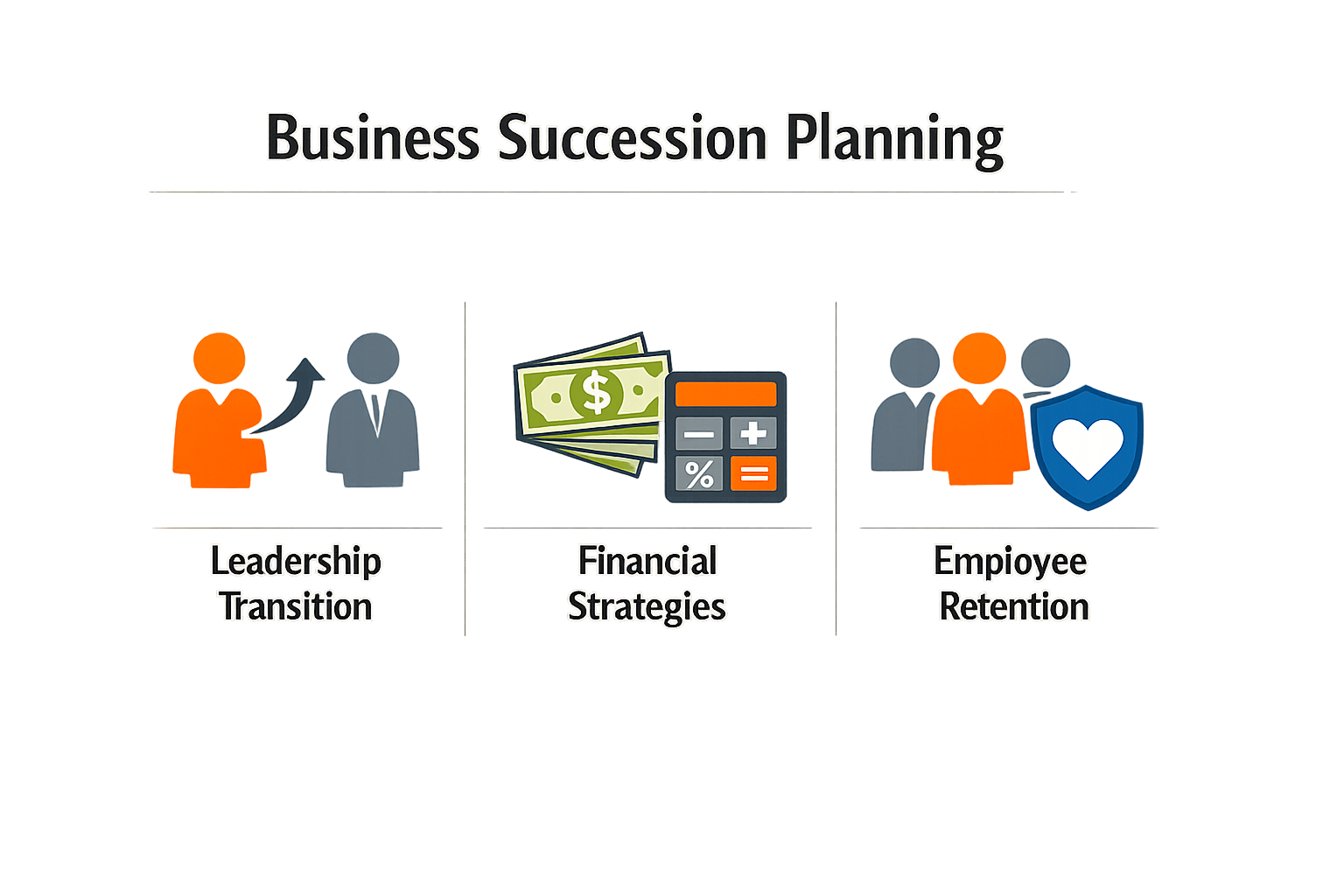
A complete succession plan addresses three questions: who leads, who owns, and how the transfer gets funded. Leadership succession identifies the person or people who will run day-to-day operations. Ownership succession determines who holds the equity and makes strategic decisions. Funding mechanisms — life insurance, buy-sell agreements, installment sales — provide the cash to execute the transfer without destabilizing the business.
The leadership piece starts with identifying successors early and developing their skills over time. That might mean a family member working in the business for years before taking over, or grooming a key employee through increasing responsibility. The goal is getting them ready before the transition happens, not hoping they figure it out after.
Ownership transfer gets more complicated. If you're selling to an outside party, the terms are negotiated and the buyer brings financing. If you're transferring to family or employees, you need a structure that lets them afford the purchase without bankrupting the business. That's where buy-sell agreements and installment sales come in — they spread the cost over time and tie payments to business performance.
Funding the Transition
The math works like this: if the business is worth $2 million and the successor doesn't have $2 million in cash, something has to bridge that gap. Life insurance on the owner can fund a buyout if the owner dies unexpectedly. A structured installment sale lets the successor pay over 5 to 10 years using business profits. A buy-sell agreement locks in the price and terms ahead of time, so there's no scrambling when the transition actually happens.
For small business owners, retirement account structures like SEP IRAs can play a role in personal financial planning alongside succession decisions, though they don't directly fund ownership transfers.
Without a funding mechanism, succession planning is just a wish list — the successor might know what they're supposed to do, but they can't afford to do it.
The honest answer: most succession plans fail not because the wrong person was chosen, but because the financial structure wasn't in place to support the transfer. The business can't generate enough cash to buy out the owner and keep operating. Creditors or family members force a sale. The new leader walks away because the deal doesn't work. A good succession plan anticipates those pressures and builds around them.
When Succession Planning Applies
This framework applies whether you're a solo consultant planning to wind down in five years, a family business transitioning to the next generation, or a partnership preparing for one partner's retirement. The specifics change — a $500,000 service business has different needs than a $10 million manufacturing operation — but the core questions stay the same. Who takes over, how do they pay for it, and what keeps the business stable during the handoff.
Depending on your circumstances, succession planning might also involve estate planning documents, tax strategy, and employee retention agreements. Those pieces support the plan, but they're not the plan itself. The plan is the decision about who runs and owns the business after you're gone, and the structure that makes that decision executable.
Why Business Succession Planning Matters
Most business owners spend years building something worth protecting. Then they skip the one step that ensures it survives them.
Without a succession plan, your company's future depends on luck. The odds aren't good. Leadership transitions triggered by retirement, disability, or death create immediate pressure — and businesses without a framework rarely handle that pressure well. Employees lose direction. Customers lose confidence. Family members argue over control. The business you built becomes the problem no one knows how to solve.
The Real Cost of Not Planning
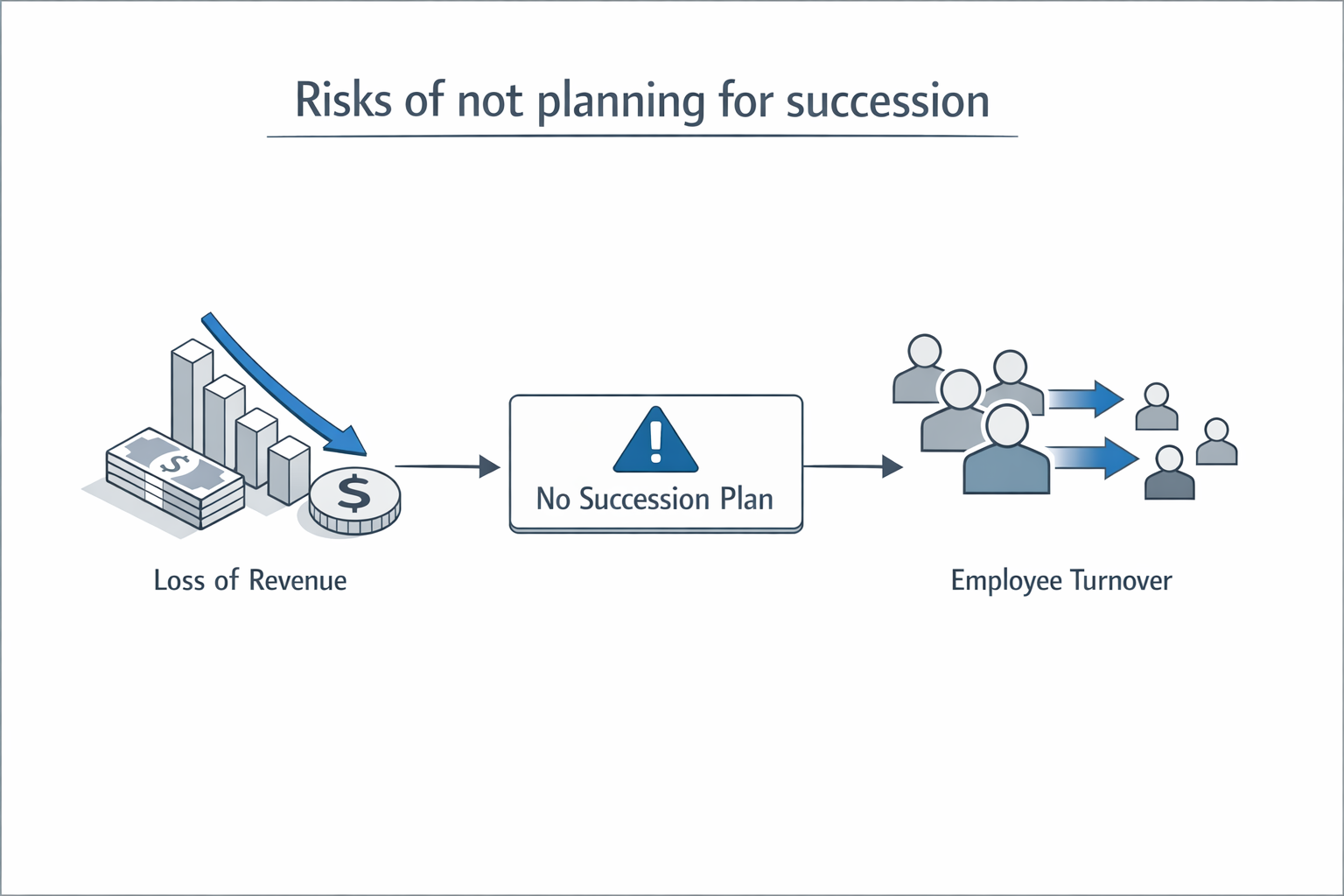
The math is straightforward. When a key owner or leader exits without a plan, the business loses institutional knowledge, customer relationships, and operational continuity all at once. Revenue drops because no one knows who's making decisions. Talent leaves because the future looks uncertain. Competitors move in because they see weakness.
For family businesses, the stakes get personal. Without clear succession terms, estate settlements can force asset sales or operational changes that weren't part of anyone's plan. The IRS doesn't wait for families to sort out ownership — tax obligations arrive on schedule whether the business is ready or not.
What Effective Planning Actually Protects
A succession plan protects four things: continuity, value, people, and legacy.
Continuity means the business keeps operating when leadership changes. Customers still get served. Payroll still runs. Strategic decisions still get made. The framework for who does what — and when — already exists.
Value means the business remains worth what you built it to be. Buyers, investors, and lenders all discount businesses without succession plans because risk is higher. A documented plan signals stability. That stability translates directly into valuation.
People means your team knows what happens next. Employees with clear paths forward stay. Employees facing uncertainty start looking elsewhere. The same applies to business partners — succession agreements prevent disputes by defining terms before emotions run high.
Legacy means the business reflects your intentions after you're gone. For owners planning to transfer leadership to family members, succession planning ensures that transfer happens on your terms. For owners planning to sell, it ensures the business is positioned to attract serious buyers at fair prices.
The businesses that survive leadership transitions are the ones that planned for them before the transition became urgent.
The Timing Question
The best time to create a succession plan is before you need one. That sounds obvious, but most owners wait until a triggering event forces the issue — a health scare, a partnership dispute, an acquisition offer. By then, options narrow and leverage disappears.
Starting early gives you time to develop successors, structure ownership transfers tax-efficiently, and build the financial mechanisms that fund transitions. Life insurance contracts, buy-sell agreements, and retirement account structures like SEP IRAs all work better when they're set up years in advance, not months.
For businesses with active operations and significant assets, succession planning also addresses how ownership interests transfer during mergers or acquisitions. Regulatory frameworks require that participants receive fair treatment during these transitions — which means having documentation in place before deals start moving.
The Framework vs. The Crisis
Businesses with succession plans handle transitions as scheduled events. Businesses without them handle transitions as crises. The difference shows up in every metric that matters — employee retention, customer confidence, operational performance, and enterprise value.
The framework doesn't have to be complicated. It just has to exist. Who takes over if you step away tomorrow? How does ownership transfer? What happens to key employees? How does the business fund the transition? Answer those questions now, and you've protected what you built. Skip them, and you've left your company's future to chance.
How to Create a Business Succession Plan
Most business owners know they need a succession plan the same way they know they need a will — it's important, they'll get to it eventually, and eventually keeps getting pushed back. The difference: your business doesn't wait for you to be ready. Creating a succession plan isn't as complicated as it sounds, but it does require working through specific steps in order.
Here's the framework that works for most small to mid-sized businesses.
Identify Your Successors
The first step is naming who takes over when you step back. For family businesses, this often means identifying which family members want the role and have the capability to handle it — two very different questions. For other businesses, it might mean promoting a key employee, selling to a partner, or planning an outside sale.
The goal is getting in the right range: someone who understands the business, has the trust of employees and clients, and can handle the financial and operational responsibilities. If you don't have an obvious successor internally, that's worth understanding now rather than during a crisis.
Step 1
Document current ownership and roles
Start by writing down who owns what percentage of the business, who holds key operational roles, and what happens to ownership if someone dies, becomes disabled, or wants to exit. Most businesses operate on handshake agreements that fall apart under pressure. Get the current structure on paper before you plan the transition.
Step 2
Set a timeline and trigger events
Decide when the transition happens and what events trigger it. Common triggers: reaching a specific age, a health event, disability, death, or simply deciding to retire. The timeline doesn't have to be exact, but it should be realistic. A succession plan that says "someday" isn't a plan.
Step 3
Value the business
You need to know what the business is worth, both for tax planning and for structuring a fair buyout if successors are purchasing ownership. This usually means hiring a business appraiser or working with an accountant who specializes in valuations. The number doesn't have to be perfect, but it should be defensible.
Structure the Financial Transition
Once you know who's taking over and what the business is worth, the next question is how they pay for it — or how you transfer ownership without a sale. Common structures include:
- Gradual buyout: The successor purchases ownership over time, often funded by business profits
- Installment sale: You sell the business and receive payments over several years
- Gift or estate transfer: You transfer ownership to family members, using gift tax exemptions or estate planning strategies
- Employee Stock Ownership Plan (ESOP): The business itself buys you out and transfers ownership to employees
For small business owners with retirement accounts like a SEP IRA, the succession plan needs to coordinate with how those accounts are structured — your business assets and retirement savings are often deeply connected.
The right structure depends on your tax situation, the successor's financial capacity, and whether you need income from the sale to fund retirement. This is where most business owners need professional help — an accountant, attorney, or financial professional who understands business transitions.
Train Your Successor
The best succession plan on paper fails if the successor can't actually run the business. Training takes longer than most owners expect — often two to five years for a full transition. The successor needs to learn operations, build relationships with key clients and vendors, and earn the trust of employees.
In practical terms, this means gradually handing over responsibilities while you're still available to answer questions and step in when needed. It's not about working less immediately; it's about working differently so the business can function without you.
Formalize the Plan in Writing
Once you've worked through the structure, put it in writing. This usually means:
- A buy-sell agreement if multiple owners are involved
- Updated operating agreements or corporate bylaws that reflect the succession structure
- Life insurance policies or funding mechanisms to support the buyout
- Estate planning documents (wills, trusts) that align with the business transition
The written plan should be specific enough that someone outside the business — an attorney, accountant, or court if necessary — can execute it without guessing what you intended. Depending on your circumstances, you may also need to consider how retirement plan assets are protected, ensuring that business assets benefit employees and their beneficiaries exclusively and aren't diverted for other purposes.
Best Practices in Business Succession Planning

A succession plan that sits in a drawer doesn't protect anyone. The framework matters less than the execution — and execution means starting early, updating regularly, and building buy-in from the people who'll carry the plan forward.
Here's what that actually means in practical terms.
Start Earlier Than Feels Necessary
Most business owners begin succession planning when they're already thinking about retirement. The problem: by that point, you're racing against a timeline. Successors need years to develop, not months. The math works like this — if you're 55 and planning to exit at 65, you have a realistic window to prepare leadership. If you're 62 and just starting, your options narrow considerably.
Starting early gives you flexibility. You can test potential successors in different roles, adjust the plan when someone doesn't work out, and address skill gaps through training or hiring. When you're ready to take the next step, the infrastructure is already in place.
Document Everything in Writing
Verbal agreements fall apart under pressure. A written succession plan should include:
- Leadership roles and responsibilities — who takes over which functions, with clear reporting lines
- Ownership transfer mechanisms — buy-sell agreements, valuation methods, payment terms
- Funding sources — how the transition gets paid for, whether through insurance, installment sales, or third-party financing
- Timeline and triggers — what events activate the plan (retirement, disability, death) and when each phase begins
The goal is getting in the right range of specificity. You don't need to script every decision, but the framework should be clear enough that successors and advisors can execute it without guessing.
Build Tax Efficiency Into the Structure
Succession planning intersects with tax planning at every turn. Qualified employee plans, for example, offer tax deferral for employer contributions, which can help fund retirement while transferring ownership. The specific structure depends on your circumstances — whether you're transferring to family, employees, or an outside buyer.
For business owners with retirement accounts like a SEP IRA, understanding distribution rules becomes part of the succession conversation. Required beginning dates for distributions affect how you time your exit and structure ongoing income.
Talk to a licensed financial professional and a tax advisor before finalizing any transfer structure. The difference between a tax-efficient transition and an expensive one often comes down to timing and entity selection.
Test the Plan Before You Need It
A succession plan is a hypothesis until you test it. That means:
- Giving successors real authority in their designated areas while you're still involved
- Running scenario exercises — what happens if the owner is unavailable for 90 days? Can the business operate?
- Reviewing financial projections — does the business generate enough cash flow to fund the buyout and sustain operations?
Most people don't realize how many assumptions break down under real conditions. A successor who looks capable in a supporting role may struggle with final decision-making authority. A buyout that pencils out on paper may strain cash flow when debt service begins. Testing surfaces these issues while you still have time to adjust.
Update the Plan When Circumstances Change
Succession plans have a shelf life. Review and update yours:
- Annually — to reflect changes in business value, key personnel, or family circumstances
- After major business events — acquisitions, divestitures, new partnerships, significant revenue changes
- After personal milestones — divorce, remarriage, birth of children or grandchildren, death of a potential successor
A common misconception: once the plan is written, it's done. In practical terms, a succession plan is a living document. The business you have today isn't the business you'll have in five years, and the plan needs to track that evolution.
The best succession plan is the one that still makes sense when you read it three years later — not because nothing changed, but because you kept it current.
Communicate the Plan to Stakeholders
Succession planning isn't a solo project. The people affected by the plan — family members, co-owners, key employees, lenders — need to understand their roles. Surprises during a transition create conflict, and conflict derails execution.
For family businesses, this means having direct conversations about who's taking over and why. For employee-owned transitions, it means transparency about valuation and payment terms. For outside sales, it means keeping potential buyers informed about your timeline.
The honest answer: these conversations are uncomfortable. Most business owners avoid them. But the cost of avoidance is higher than the cost of clarity.
Secure Adequate Funding
A succession plan without funding is a wish list. The most common funding mechanisms:
- Life insurance — provides immediate liquidity for buy-sell agreements funded at death
- Installment sales — spreads payments over time, but requires the business to generate sufficient cash flow
- Third-party financing — banks or outside investors provide capital, but add debt service obligations
- Retained earnings — accumulated cash funds the buyout, but reduces working capital
Depending on your circumstances, you may use multiple funding sources. The framework is straightforward: calculate the buyout amount, identify the funding gap, and structure a solution that doesn't cripple the business post-transition.
Involve Professional Advisors Early
Succession planning touches legal, tax, financial, and operational domains. No single advisor sees the whole picture. Assemble a team:
- Attorney — drafts buy-sell agreements, trusts, and entity documents
- Accountant — models tax implications and structures transactions
- Financial professional — coordinates insurance, retirement accounts, and funding strategies
- Business consultant or coach — helps develop successors and transition leadership
The real question is timing. Involving advisors after you've already made structural decisions limits their ability to optimize the plan. Bring them in early, when the framework is still flexible.
Common Mistakes in Business Succession Planning
Most business owners know they need a succession plan. Most business owners don't have one. The gap between knowing and doing comes down to a handful of predictable mistakes — the kind that seem minor until they're not.
The honest answer: succession planning fails most often not because of bad strategy, but because of timing, communication, and ownership structure decisions that seemed reasonable at the time. Here's what actually derails plans and how to avoid it.
Waiting Until a Crisis Forces the Issue
Succession planning done under pressure is succession planning done poorly. When a health scare, partnership dispute, or market opportunity creates urgency, the framework that should guide decisions doesn't exist yet. The result is reactive choices made with incomplete information.
The math works like this: a plan developed over 18 to 24 months allows time for tax strategy, leadership development, and ownership transition mechanics. A plan developed in 90 days because someone needs to retire or sell skips most of that.
Start the conversation when the business is stable and the key stakeholders are healthy. The goal is getting the framework in place before it's needed, not scrambling to build it when the clock is running.
Concentrating Ownership Without Succession Safeguards
A common misconception: if one or two people own most of the business, decision-making is cleaner and succession is simpler. In practical terms, concentrated ownership without a clear succession mechanism creates the opposite problem — what happens if that majority owner becomes unavailable?
The framework for ownership diversity isn't about dilution — it's about ensuring that the business can continue operating if one person steps away. This is where buy-sell agreements, cross-purchase arrangements, and key-person insurance become relevant. The structure should answer: who has the authority to make decisions, and how does ownership transfer if someone exits?
For business owners managing retirement accounts alongside succession planning, understanding how different account structures work is worth the time. What Is a SEP IRA? A Guide for Self-Employed Workers covers one option that fits many small business scenarios.
Skipping the Leadership Development Piece
Ownership transfer and leadership transition are not the same thing. A successor can own the business on paper and still lack the operational knowledge or stakeholder relationships to run it effectively. This gap shows up most clearly in family businesses, where the assumption is that proximity to the business equals readiness to lead it.
The real question is: does the successor know how decisions get made, where the institutional knowledge lives, and which relationships keep the business running? If the answer is no, the transition timeline needs to account for that.
Leadership development takes years, not months. Successors need time in operational roles, exposure to key clients and vendors, and a clear understanding of the business's financial levers. Skipping this step to accelerate a timeline is a trade-off with consequences that show up after the transition is complete.
Failing to Communicate the Plan to Stakeholders
A succession plan that lives in a lawyer's file and nowhere else isn't a plan — it's a document. The framework only works if the people it affects know it exists and understand their role in it.
Stakeholders include family members, business partners, key employees, lenders, and in some cases, major customers or suppliers. Each group needs different information, but all of them need to know the business has a plan and that leadership continuity is addressed.
Communication doesn't mean publishing the full legal structure. It means making sure the people whose decisions or cooperation matter know what happens next and when. Surprises during a transition create friction. Clarity in advance reduces it.
Ignoring Tax and Regulatory Implications
Succession planning intersects with tax law, estate planning, and in some industries, regulatory requirements. Treating it purely as an operational decision misses the financial mechanics that determine whether the plan is feasible.
The separation of business structures for compliance purposes — such as distinguishing between ESOP and non-ESOP plan components — highlights how regulatory frameworks shape succession options. The complexity isn't optional; it's built into the rules governing ownership transfer and retirement plan administration.
Talk to a licensed financial professional and a business attorney who specialize in succession. The goal is understanding which structures apply to your situation and what the tax implications are before you commit to a path. Retrofitting tax strategy after the fact is expensive and sometimes impossible.
Treating the Plan as Static
Business circumstances change. Markets shift, key people leave, family dynamics evolve, and the successor you identified five years ago may no longer be the right choice. A succession plan written once and never revisited becomes outdated the moment conditions change.
The framework should include a review schedule — annually at minimum, and whenever a major business event occurs. Ownership percentages, leadership roles, and transition timelines all need periodic reassessment.
Succession planning is not a one-time project. It's a process that adapts as the business and its stakeholders evolve. The plan that works today may need adjustment next year, and that's expected.
Frequently Asked Questions about Business Succession Planning
When should a business owner start succession planning?
Most business owners wait too long. The honest answer: start planning at least five to ten years before you expect to transition out. This timeline gives you room to identify successors, train them, address tax implications, and adjust the plan as circumstances change.
Starting early also means you're planning from a position of strength rather than reacting to a health crisis or unexpected market shift. The framework works better when you're not under pressure.
What's the difference between succession planning and estate planning?
Estate planning addresses what happens to your personal assets when you die. Business succession planning focuses on who runs the company and how ownership transfers—whether you retire, become disabled, or pass away.
The two overlap when your business is a major asset in your estate. A solid succession plan coordinates with your estate plan to minimize taxes and ensure your family's financial security. But they're separate frameworks with different goals.
Do I need succession planning if I plan to sell to an outside buyer?
Yes. Even if you're planning an external sale, succession planning protects the business until that sale happens. It addresses what occurs if you're suddenly unable to lead before the deal closes, and it helps maintain company value during the transition.
Buyers also look more favorably on businesses with documented leadership continuity. A succession plan signals that the company can operate independently of the founder—which makes it more attractive and often more valuable.
How does key-person insurance fit into succession planning?
Key-person insurance provides the business with a cash infusion if a critical leader dies or becomes disabled. That cash can fund a buyout, cover lost revenue during the transition, or recruit replacement talent.
It's a financial backstop, not a succession plan by itself. The insurance gives you resources to execute the plan under the worst circumstances. Most closely held businesses with one or two essential leaders should consider it as part of the overall framework.
What happens if I don't have a succession plan?
Without a plan, the business faces uncertainty. If something happens to you, your family, partners, and employees won't know who's in charge or how ownership transfers. This often leads to disputes, rushed decisions, and value destruction.
In many cases, the business gets sold under pressure at a discount, or it simply closes. The lack of a plan doesn't just affect you—it affects everyone who depends on the company's continued operation.
Can I change my succession plan after I create it?
Changes to a succession plan are necessary. A succession plan isn't a static document. Review it every two to three years, or whenever something significant changes—new partners, shifts in company value, changes in tax law, or personal circumstances like divorce or health issues.
The goal is keeping the plan aligned with current reality. What made sense five years ago may not fit today's business structure or your current intentions.
Do small businesses really need formal succession planning?
Yes, especially if the business supports your family or employs other people. Small businesses are often more vulnerable to leadership disruption because they rely heavily on the owner's relationships, expertise, and day-to-day involvement.
A formal plan doesn't have to be complicated, but it should be documented. Even a simple framework—naming a successor, outlining a buyout structure, and coordinating with insurance—provides clarity that protects everyone involved.
For self-employed individuals considering retirement account options as part of their succession and exit strategy, a SEP IRA offers a tax-advantaged way to build personal wealth alongside business planning.
Conclusion: Securing Your Company's Future
Business succession planning isn't something most owners lie awake thinking about — until a health scare or a partner conflict forces the conversation. By then, the options narrow. The framework outlined here gives you the starting point: identify successors, value the business accurately, fund the transition, and document everything in writing.
The honest answer is that most business owners wait too long. They assume they'll have time to work out the details later, or that the next generation will figure it out. The reality is that transitions without a plan create legal disputes, tax penalties, and operational chaos. A well-structured succession plan protects the company's future by ensuring that assets aren't misused and that the interests of employees and their families remain secure — even when the unexpected happens.
When you're ready to take the next step, talk to a licensed financial professional who understands both the business valuation side and the insurance or retirement plan structures that can fund the transition. If you're self-employed or running a small team, understanding vehicles like a SEP IRA or SIMPLE IRA can help you build retirement security while planning for succession.
The goal isn't perfection — it's getting the framework in place so that when the time comes, the business you built continues without you having to be there to hold it together. That's what succession planning actually does: it turns your life's work into something that outlasts you.